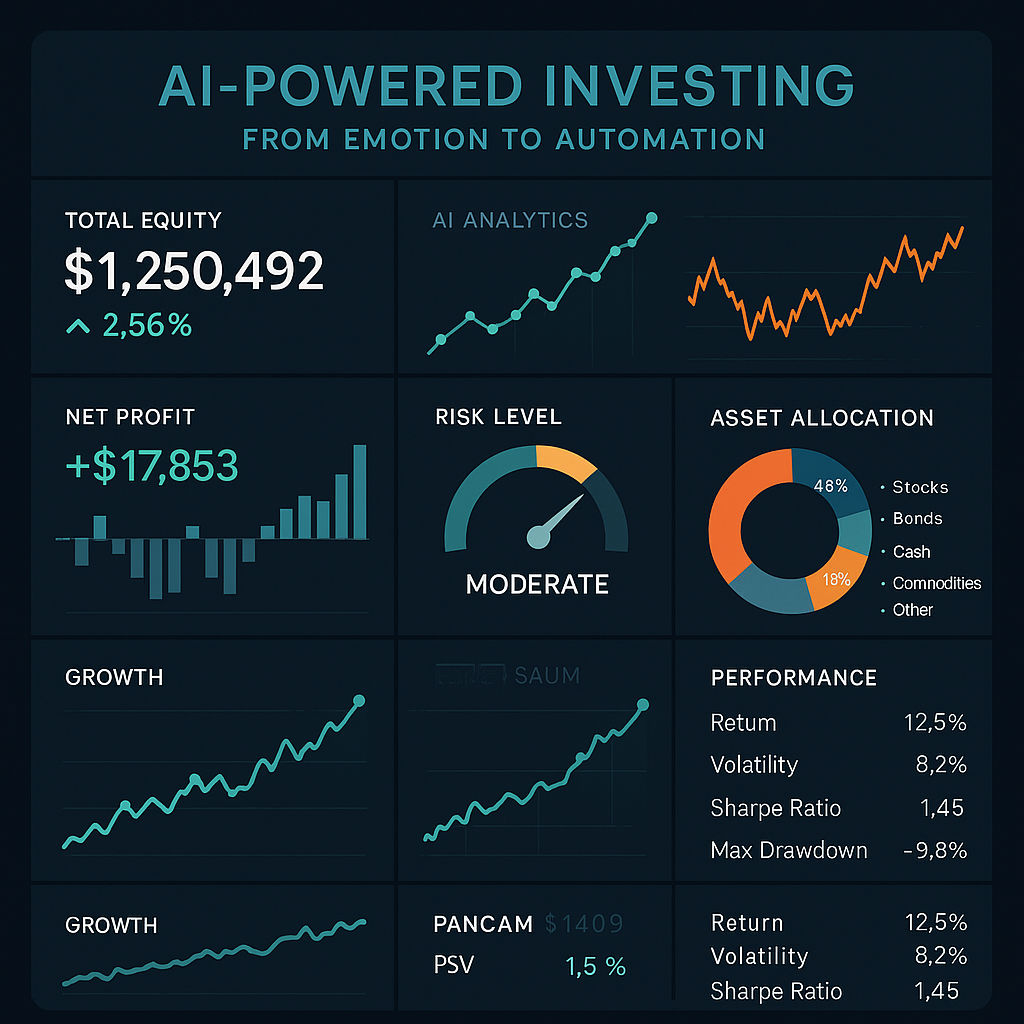

The End of Gut-Driven Investing

Lukra.AI
The End of Gut-Driven Investing
4:31
The era of instinctual investing is being replaced by data-driven precision, as advanced AI and analytics empower financial decision-makers to outperform emotion-based strategies.
Why Gut-driven Investing Falls Short in Today's Markets
For decades, gut-driven investing—relying on intuition, experience, and subjective judgment—defined how many approached financial markets. While some legendary investors have made fortunes on instinct, today’s environment is fundamentally different. Massive increases in trading volumes, the speed of information dissemination, and the complexity of global markets have outstripped the capacity of individual intuition to keep pace.
Human judgment is inherently vulnerable to cognitive biases, emotional reactions, and incomplete data. In a landscape where milliseconds can separate gains from losses and where thousands of variables influence outcomes, intuition alone is simply too limited. The margin for error grows substantially as data density increases and market dynamics become ever more interdependent.
The Rise of AI and Quantitative Strategies in Finance
The digital transformation of finance has ushered in an era where artificial intelligence and quantitative models are essential. AI algorithms can analyze terabytes of structured and unstructured data—news, earnings reports, social sentiment, and macroeconomic indicators—in real time, surfacing patterns and anomalies invisible to the human eye.
These technologies not only process information faster but also adapt through continuous learning. Quantitative strategies leverage statistical rigor to identify market inefficiencies, optimize portfolio allocations, and manage risk with precision. The combination of AI pattern recognition and automation allows investors to capitalize on fleeting opportunities, execute complex trades, and maintain discipline under volatile conditions.
Key Capabilities of Modern Autonomous Investing Platforms
Today’s autonomous investing platforms offer capabilities far beyond traditional trading tools. Multi-model intelligence allows for the simultaneous deployment of diverse strategies, each tuned to specific market conditions. Real-time data integration ensures every decision is based on the latest available information, reducing lag and minimizing the impact of outdated insights.
Automation removes emotional interference from execution, ensuring consistent adherence to strategy. Advanced analytics provide transparency into performance drivers, attribution, and risk exposure. Adaptive learning algorithms continually refine their approach, adjusting to new data and evolving market regimes—delivering an edge unattainable through human intuition alone.
Integrating Intelligent Tools into Your Revenue Operations
For RevOps-focused SMBs and startups, the integration of intelligent investing tools parallels the digital transformation already underway in sales, marketing, and customer success. Connecting autonomous platforms with data pipelines, analytics dashboards, and CRM systems streamlines workflows, enhances forecasting, and provides role-based insights that drive better decisions across the organization.
By automating repetitive, error-prone tasks—such as data consolidation, opportunity scoring, and pipeline management—teams can redirect focus to strategy, innovation, and customer engagement. Intelligent tools not only improve operational efficiency but also ensure that every financial decision is grounded in robust, real-time analytics rather than hunches or guesswork.
The Future of Financial Decision-Making: Emotion-Free and Data-Powered
The end of gut-driven investing is not a loss, but an evolution. As financial markets become ever more complex, the winners will be those who harness data density, AI pattern recognition, and automation to drive their decisions. Emotion-free execution and model-based logic reduce risk, enhance scalability, and enable rapid adaptation in the face of market volatility.
For organizations seeking to maximize revenue and minimize operational friction, integrating autonomous investing solutions is no longer optional—it is a competitive imperative. Those who adapt will not only outperform their intuition-reliant peers but will also set new standards for precision, transparency, and performance in the future of investing.
